
Compliance violations in the California cannabis industry can put a business’s license and operations at risk. The Department of Cannabis Control (DCC) is inspecting to find problems such as inventory tracking, cannabis waste, security footage, labeling and licensing. Many of these violations are attributable to common oversights that operators can rectify prior to an inspection.
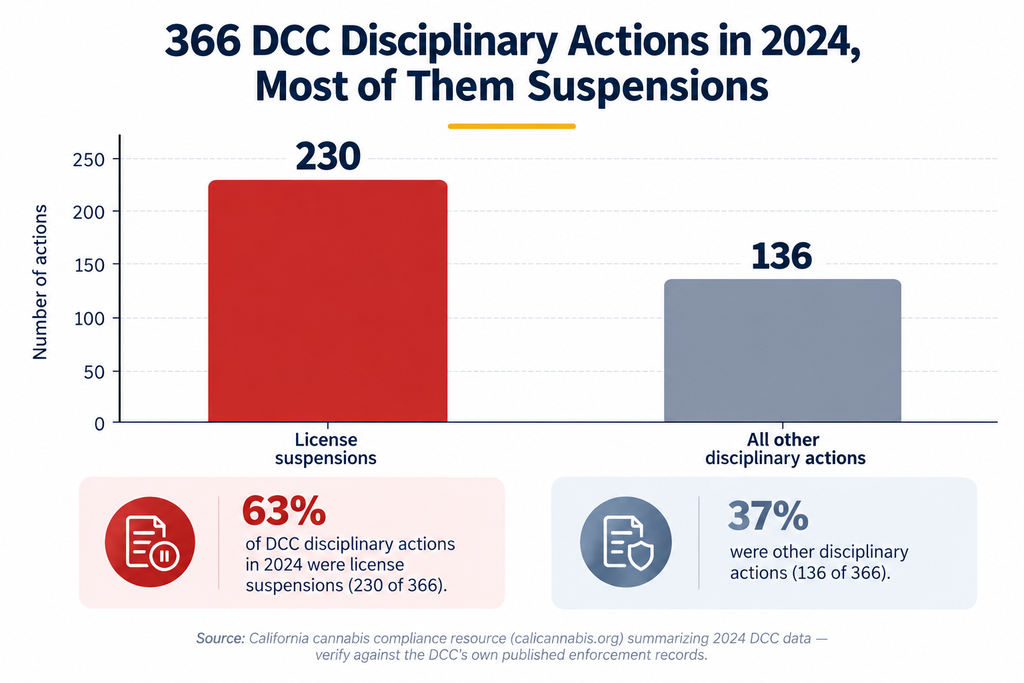
Those figures come from compliance resources summarizing DCC data, so check the DCC’s own enforcement page before quoting exact numbers. The direction is clear either way: enforcement is active, and suspensions are a routine outcome rather than a rare one. Here are ten violations that keep showing up in enforcement records and inspection checklists. They are not ranked by frequency, since no public source ranks them reliably.
The Ten
1. Metrc inventory discrepancies. Businesses have to reconcile their physical inventory with their track-and-trace records. Unexplained inventory shortages have been found in DCC enforcement decisions to support concerns of possible diversion.
2. Expired, mis-tagged, or un-tagged packages. Inspectors quickly can identify packages missing from Metrc or with incorrect or expired tags. Such errors can result in citations at an inspection.
3. Lack of or incomplete waste management plans. In California, cannabis businesses must have a written waste management plan. If the documents are missing or the plan has gaps, the agency can take enforcement action.
4. Destruction logs are not accurate. Operators will have to reconcile their destruction logs to their physical inventory and Metrc records. Inspectors may red-flag inconsistencies even when the operator made an honest mistake.
5. Wrong cannabis waste. Businesses need to mix cannabis waste with enough non-cannabis material so it is not recognizable. If the waste still resembles cannabis, inspectors can cite the business for improper disposal.
6. Video retention is not good enough. Security cameras may take footage but not keep it for the required time. Key areas may also not be monitored due to coverage gaps. Problems tend to arise after a situation where operators want footage they can no longer obtain.
7. Mislabeling and packaging. Businesses must ensure that the labels and packaging are an accurate representation of the product. Such potency or other product information mistakes could trigger recalls and regulatory scrutiny.
8. Failure to report changes to the DCC. When regulations require that, operators must report certain changes such as ownership transfers, new financial interests and premises modifications. License can be in jeopardy due to a missing report or approval. Operators may not discover the problem until renewal.
9. Not meeting renewal deadlines. Operators must renew their license prior to expiration. If a business fails to meet the deadline, it can be disallowed from operating until it regains its license.
10. Overlooking labor and local requirements. Recently, the DCC has called out compliance with labor peace agreements, and regulators also check local authorization in addition to state licensing. Operators can miss these requirements even when they keep their state paperwork in order.
How the state ranks the damage
The DCC disciplinary guidelines divide breaches into three categories according to their severity. Class I includes serious problems of diversion, public safety or willful misconduct. Class II is for lapses in records, training and operations, and Class III is for administrative and technical failures. However, if an inspector suspects the missing product was diverted, an inventory discrepancy can be viewed with more seriousness.
There is also a change coming. A bill moving through the legislature would require the DCC to adopt a risk-based enforcement framework starting in 2028, focusing on material threats rather than minor technical violations. That is a proposal, not current law, and it does not help an operator who gets inspected this year.
What to do with this list
Pick the three that would be easiest for an inspector to prove and check them this week: your Metrc reconciliation, your waste plan and destruction logs, and how many days of video you can actually pull. Those cost almost nothing to verify now, and a great deal to explain later.
Before Your Next Inspection, Check What’s Missing
A missing record or camera footage you can not retrieve can become a much bigger problem during an inspection.
Take time now to identify where your operation might be falling short. Massive Security can help strengthen your on-site security and surveillance before small oversights become costly problems.