
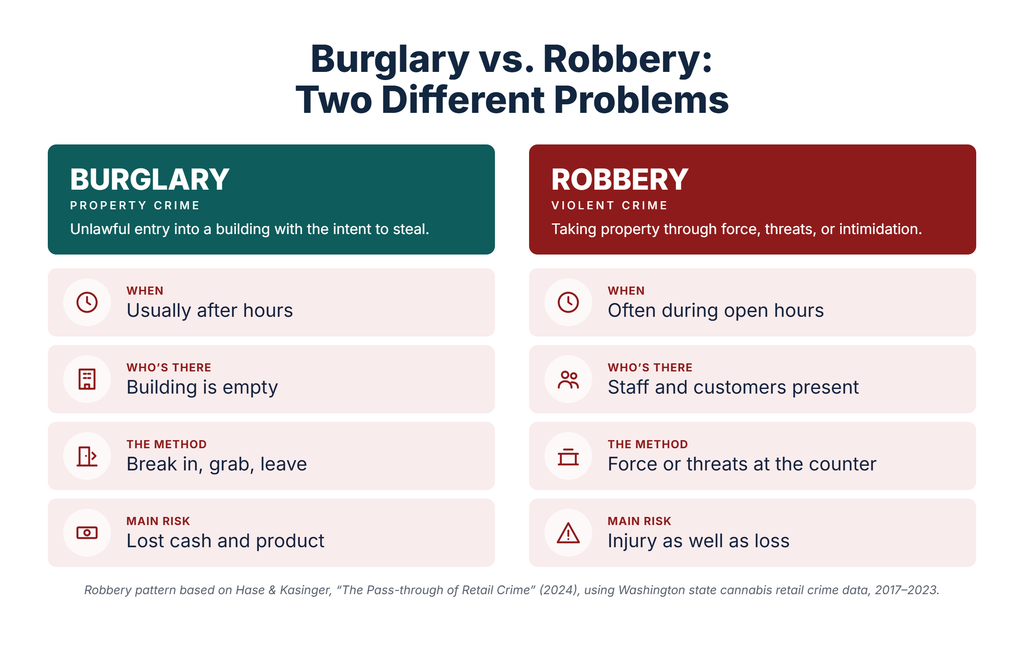
Ask most owners to picture a robbery and they picture 3 a.m.: a dark street, broken glass, an alarm going off. That is a burglary, and it is real. But the research on cannabis retail crime describes something different and, in some ways, more dangerous. In Washington state, one analysis of cannabis store crime found that the incidents were predominantly armed robberies during store hours, with offenders taking cash from the register, demanding access to the safe, or clearing shelves while staff stood there.
That difference matters, because the two problems call for different defenses. A burglary is a question of locks, alarms, and who is watching the building overnight. A robbery is a question of what happens at the counter at 2 p.m.
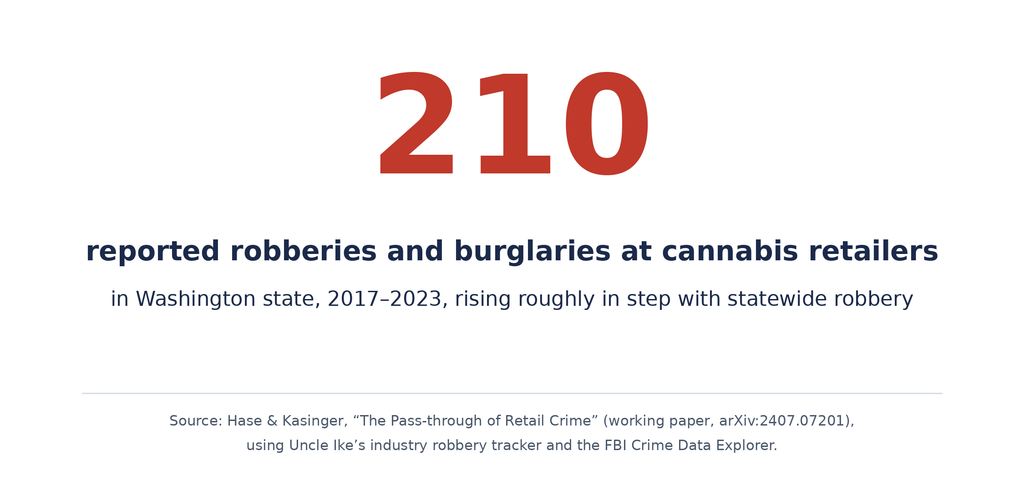
The same analysis counted 210 reported robberies and burglaries at Washington cannabis retailers between 2017 and 2023, and found the trend rose roughly in step with robberies across the state. That is worth sitting with. Cannabis stores are not only a special target, they are also part of a broader rise in retail crime. It also notes that these incidents are often violent: employees and customers have been held hostage, assaulted, shot at, and in some cases killed.
What actually puts a business at risk
The industry-wide reasons are well known: cash-heavy sales because of federal banking limits, compact high-value product, and locations that are easy to find. You can not change those. What differs from one business to the next is how much of that risk you have left on the table. These are the factors worth checking in your own operation.
1. Cash within easy reach. Demanding access to the safe is a standard part of these robberies, so the amount of cash a person can reach in a few minutes is the amount at stake. Industry security guides consistently recommend limiting cash at registers and moving the excess to a bolted-down safe through a drop slot, so no one has to open the main compartment mid-shift.
2. Routines anyone could learn. If your opening time, closing time, cash pickup, and delivery runs happen at the same hour every day, someone watching for a week knows exactly when to show up. Varying deposit and delivery days and times is one of the cheapest changes on this list.
3. An unprotected front door. Many robberies start with someone simply walking in. A staffed, controlled entry point, where someone sees every person before they reach product or cash, acts as a screen as well as an age check. It also puts distance between a would-be robber and the register.
4. The walk out at closing. The risk does not end when the doors lock. Staff leaving with the day’s cash or product, alone and at night, are easier targets than a staffed store. Operators in the Sacramento area have described being followed after closing. Two people closing together, and an escort to the car, change that picture.
5. Cash and product on the move. Bank runs, transfers between locations, and deliveries put cash and inventory in a vehicle on the road. Security guides advise against moving large amounts of cash in personal vehicles and suggest armored transport or two-person crews, with GPS tracking and lockboxes for delivery vehicles.
6. Information that travels. Security vendors have pointed to cases where employees pass along schedules, access codes, or how the store operates. Most staff never would. But a need-to-know approach to alarm codes and cash schedules, and changing codes whenever someone leaves, costs very little.
7. No plan for the moment it happens. Most workplace-safety guidance for retail robbery rests on one principle: cash and product are replaceable, people are not. Staff should know, before it ever happens, that they are never expected to resist or chase anyone, who triggers the alarm and how, and what gets documented afterward. A rehearsed plan keeps a frightening moment from becoming a worse one, and it’s something an inspector or insurer will want to see written down.
Where to start
You do not need to fix all seven at once. Pick the two that describe your business most honestly. For most owners that is cash within reach and predictable routines, because both can change this week without any new equipment. The aim is not to make a store impossible to rob. It is to make it a clearly worse choice than the next one, and to make sure that if the worst does happen, the people inside are as protected as the product.
Strengthen Your Store’s Security Before a Robbery Happens
You can not eliminate every risk, but the right security measures can help protect your staff, customers, and inventory. Massive Security provides on-site security and surveillance solutions to help cannabis retailers address vulnerabilities and improve their security coverage.
Need a stronger security plan for your store? Talk to Massive Security today.