
Quick Compliance Check
Before reading, ask yourself:
🟨 Are all security guards properly licensed?
🟨 Is your security plan up to date?
🟨 Are your cameras paired with trained personnel?
🟨 Have you reviewed your access controls this year?
🟨 Did you involve a security consultant before opening?
If you answered “No” to any of these, your business may have avoidable compliance risks.
Most cannabis business owners are not cutting corners on purpose. Security often gets addressed once, then neglected amid DCC filings, local ordinances, inventory tracking, and retail operations. That is how the mistakes below happen, not from negligence, but from treating security as a box to check instead of a system to maintain.
1. Using guards who are not actually licensed to work there
This is the single most common and most expensive mistake. Under California law, only a Bureau of Security and Investigative Services (BSIS)-licensed Private Patrol Operator (PPO) can contract to provide security guard services to a business. A guard card and a firearms permit are not enough on their own: the guard must be a W-2 employee of a PPO, not an independent contractor, a “1099 guard,” an off-duty officer moonlighting without a PPO behind them, or a friend of the owner working cash-in-hand.
Deploying unlicensed or improperly employed guards is not a gray area. Unlicensed security can lead to DCC citations and serious penalties, including a $5,000 fine and up to a year in county jail. Before hiring any guard, verify their BSIS Guard Card and the company’s PPO license at bsis.ca.gov.
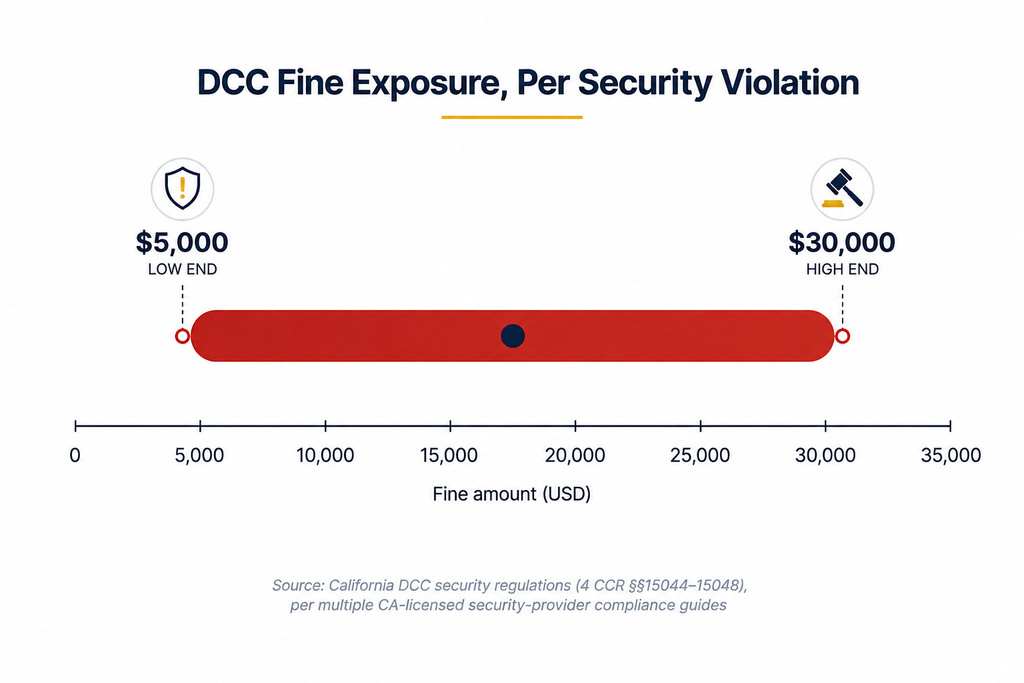
2. Cameras are valuable, but they are not a substitute for trained security personnel.
Video surveillance is necessary, but the DCC does not treat it as sufficient on its own. A wall of cameras recording an empty store overnight satisfies part of your security plan and does nothing to stop a break-in in progress. Most licensed dispensaries must maintain trained security personnel during operating hours in addition to 24/7 recorded video; the two requirements are separate, not interchangeable.
The mistake usually takes two forms: relying on cameras alone or having guards without clear instructions on what to watch for. A camera system tells you what happened. A trained, briefed guard is what changes whether it happens at all.
3. Letting the security plan go stale
A DCC security plan is not a one-time filing. As your layout, hours, staffing, or local ordinance requirements change, the plan and the guard post orders that flow from it are supposed to change with it. Inspectors can and do cite gaps between what is on paper and what’s actually happening on site: missing documentation, outdated post orders, or a plan that describes a security setup you no longer run.
A plan that was compliant at licensing can be non-compliant eighteen months later without a single operational issue; it just fell out of date. Treat your annual security plan review the same way you treat any other recurring compliance deadline, not as an afterthought.
4. Underestimating how much loss comes from inside the building
Owners tend to plan security around the dramatic scenario, a break-in, a robbery, and underweight the quieter one. Some estimates attribute up to 90% of dispensary losses to employee theft. While the figure is based on a single industry source, it highlights an important point: security budgets should address internal theft as well as external threats.
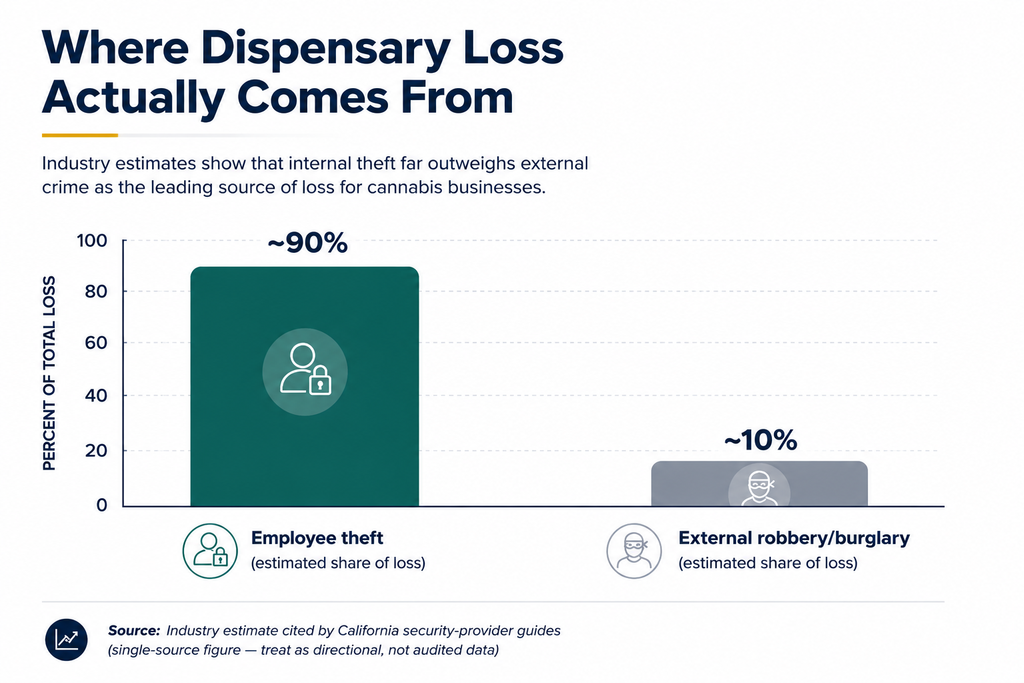
A visible, trained guard can deter both external and internal threats. However, the security plan must also address internal risks through controlled access to cash and storage areas, entry and exit logs, and cameras covering back-of-house operations—not just the sales floor.
5. Bringing in security as a last step instead of a first one
The most common planning mistake happens before opening day, not after. New operators frequently wait until the buildout phase, sometimes weeks before opening, to engage a security partner. By then, camera placement, access points, and safe locations are already built into the architecture, and retrofitting a real security plan around a finished space costs more and covers less than designing it in from the start.
Late security planning is often reactive, forcing businesses to work around an existing space instead of their actual needs. Bringing in a security consultant during design can create a stronger, more cost-effective plan from the start.
Where This Leaves You
None of these five mistakes are unusual. In fact, they often result from treating security as a one-time purchase instead of an ongoing program. Effective cannabis security is more than installing cameras or hiring guards. It involves maintaining policies, training your team, staying compliant, and keeping up with new risks.
If more than one of these challenges resonates with you, know that you are not alone. The good news is that most security gaps can be detected and fixed before they lead to theft, compliance violations, or operational disruptions.
View security as a program, not a one-time investment.
Review Your Security Before Regulators or Criminals Do
Security risks often hide in the details. A proactive review can uncover gaps, strengthen your operations, and help prevent costly losses.
Massive Security helps cannabis businesses build security programs that ensure regulatory compliance and protect employees and valuable inventory, whether they are opening a new facility or evaluating an existing one.